Sherwood lab Overview

Our long-term goal is to elucidate the genetic networks that regulate cell invasions through basement membranes, the dense, sheet-like extracellular matrix that underlies most cells and tissues. Basement membranes are composed of a diverse and highly cross-linked protein network that separates cells into distinct tissue compartments. Despite this property, a few specialized cells acquire the ability to cross through basement membranes during normal development to disperse (e.g., neural crest, germ cells, myoblasts) and to form organs (e.g., blood vessel formation, placentation, budding organ growth). This invasive activity relies on the integration of distinct cellular behaviors, including polarization, adhesion, and transmigration through basement membranes. These same cellular behaviors are also co-opted or aberrant in a number of human diseases, most notably in metastatic cancer.
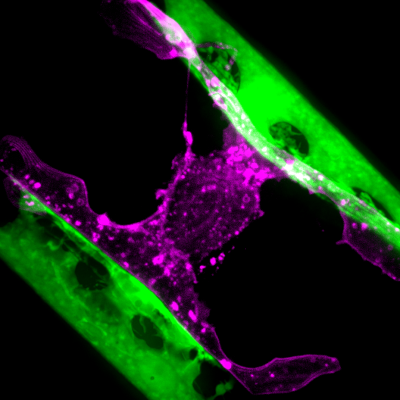
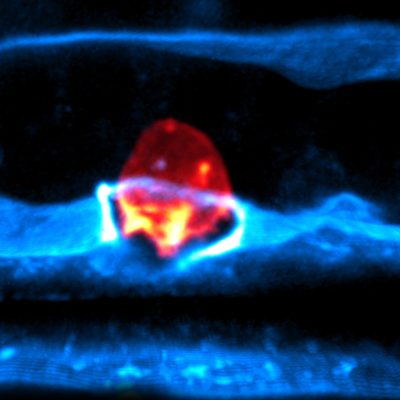
The mechanisms underlying cell invasion remain poorly understood. In development and cancer, these invasions occur in complex and inaccessible environments. Thus, it has been difficult to analyze this process directly in vivo. To gain insights into cell invasive behavior, our group is analyzing anchor-cell (AC) invasion into the vulval epithelium in Caenorhabditis elegans. Connection of the uterus and vulva in C. elegans is initiated by the uterine AC, which invades through two basement membranes to establish contact with the central vulval cells. Our lab is combining single-cell visualization with forward genetic and functional genomic approaches to uncover the molecular mechanisms that regulate the distinct cellular behaviors that control invasion. Ultimately, it is our hope that this work will help elucidate the molecular networks that endow invasive cells with their unique and fascinating properties.

Current Projects in lab:

(1) Characterization of newly identified genes that regulate invasion.  We have recently completed an entire genome RNAi screen and identified over 60 conserved genes that regulate invasion.  While several of these genes, such as integrin and the proto-oncogene homolog fos-1 have already been implicated in controlling cell invasion, most have not previously been associated with invasive behavior.  We are currently using cell biological assays with molecular analysis to characterize how these genes regulate AC invasion.

(2) Understanding the mechanisms that polarize the AC.   To invade cells must polarize their invasive cell membranes toward the basement membrane.  We have recently identified a novel role for the netrin pathway in controlling the polarization of the AC toward the basement membrane.  We are currently investigating the mechanisms by which netrin polarizes the AC.

(3) The role of basement membrane composition in regulating cell invasion.  Basement membranes are constructed from over 50 different proteins.  To explore how basement membrane composition influences cell invasive behavior, we are analyzing basement membrane composition under the AC during invasion and examining how perturbations in basement membrane composition regulates invasion.   Strikingly, we have found that when the basement membrane protein SPARC is overexpressed, it specifically enhances the ability of the AC to penetrate the basement membrane.  SPARC is upregulated in a number of metastatic cancers, where it might play a similar role. 

(4) Identifying the gene regulatory network controlling AC invasion.  Through our whole genome RNAi screen we have identified over 10 putative transcription factors that are required for AC invasion.  We are characterizing the interactions of these transcription factors to understand the core gene regulatory network underlying AC invasion.

(5) Examining vesicular apparatus organization during AC invasion. The AC contains numerous granules during invasion and these granules appear to be polarized toward the site of invasion.   We are currently investigating the organization of the vesicular apparatus (ER, Golgi, Endosomes, Lysosome) of the AC and examining how it may become polarized during invasion.

(6) Real time analysis of AC invasion.  To better understand the dynamic cellular and molecular events that underlie cell invasive behavior, we are tagging basement membrane proteins, the AC, and proteins identified from our screen with GFP derivatives and performing time-lapse microscopy.   The simultaneous visualization of AC behavior, basement membrane composition, and the localization of genes that regulate this process are allowing our group to elucidate the dynamic interplay of the molecules and molecular pathways that control invasion. 


Dave Sherwood
Assistant Professor of Biology
Pew Scholar & American Cancer Society Research Fellow


Contact Information:

Lab Phone:

(919) 613-9037

Lab Address:

Sherwood Lab
Department of Biology
Duke University
French Family Science Center
Room #4244
Durham, NC 27708

Regular Mail Address:

Department of Biology
Duke University
Box 90338
Science Drive
Durham, NC 27708


Email addresses  (add @duke.edu):

Daniel Agarwal: danielagarwal

Swathi Appachi: swathi.appachi

Qiuyi Chi: qiuyi.chi

Sarah Durbin: sarah.durbin

Shinji Ihara: si18

Elliott Hagedorn: elliott.hagedorn

David Matus: david.matus

Ginger Miley: grkmiley

David Sherwood:  david.sherwood

Zheng Wang: zheng.wang2

Josh Ziel: jwz