Teleology
How shall we understand goal-directed systems? What explains the ability of a bacterium to home in on its food? How is a cell able to migrate to a target location in a developing embryo? How is a homing torpedo able to track and move in on a target ship? What explains human purposefulness, our ability to experience wants, preferences, and cares and to act to satisfy them? What explains goal-directedness in organisms generally? Is evolution goal directed? Are there purposeful machines? What is teleology?
There is something magical about these systems, in which entities seem to be guided by the future, the acorn seemingly guided by the oak tree it will once day become. Somehow … (See teleology.)
Complexity
In a 2010 book (Biology’s First Law) with philosopher Robert 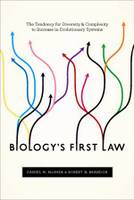 Brandon, we argued that complexity change in evolution is governed by what we call the Zero-Force Evolutionary Law (ZFEL). The law says that in the absence of selection and constraint, complexity (in the sense of differentiation among parts) will tend to increase. Further, even when forces and constraints are present, a tendency for complexity to increase is always present. The rationale is simply that when selection is absent, the parts of an organism should tend spontaneously to accumulate variation, and therefore to become more different from each other. In the same way, the pickets of a picket fence will tend to become different from each other as each picket accumulates its own unique features, one picket losing a chip of paint, another acquiring a sticky pollen grain, a third getting knocked and dented by a passing animal, and so on. In the same way, absent selection and constraint, the degree of differentiation among cells should increase with the accumulation of heritable accidents (e.g., mutation), leading eventually to an increase in the number of cell types. … (For more, including updates: complexity.)
